
Social Anxiety
What is social anxiety and how does social anxiety maintain itself?

Insights into my Week
Speaking to people who have social anxiety is not something that is unique to this week but it has been a topic of discussion in various places over the last 7 days. It has given me time to reflect that social anxiety is a common disorder and often misunderstood to be those who are ‘shy’ or ‘quiet’. Social Anxiety Disorder (SAD) in the general European population has been found to have a lifetime prevalence of nearly 7% [1], providing evidence of how common it can be.
There are many aspects of social worries that most people experience because, as humans, we are social creatures. The majority of the population do not want to be rejected, want to be liked and often care about what others think. From a personal view, I know that I often care about what others think and can be classed as a ‘people pleaser’ for this reason. So what is the difference between everyday social worries to those who are diagnosed with Social Anxiety Disorder?
Insights to Take Away
The Diagnostic Statistical Manual (American Psychiatric Association, 2013[2]), states that to be diagnosed with social anxiety disorder you need to experience the following:
Fear/anxiety about one or more social situations in which the individual is exposed to possible scrutiny by others.
Individuals fear they will act in a way or show anxiety symptoms that will be negatively evaluated
Social situations almost always provoke fear or anxiety.
The fear or anxiety is out of proportion to the actual threat posed by the social situation and to the sociocultural context.
Social situations are avoided or endured with intense fear or anxiety.
Anxiety causes significant distress and/or impairment to functioning.
Anxiety is persistent, typically lasting for 6 months or more.
Anxiety is not due to substances or another psychological disorder
This list is quite clinical and to help you understand social anxiety in more detail, we can explore how it presents day-to-day using a formulation. If you do not know what a formulation is, it basically means creating a diagram to explain a client's symptoms. I have written a blog about formulations here, if you would like to know more.
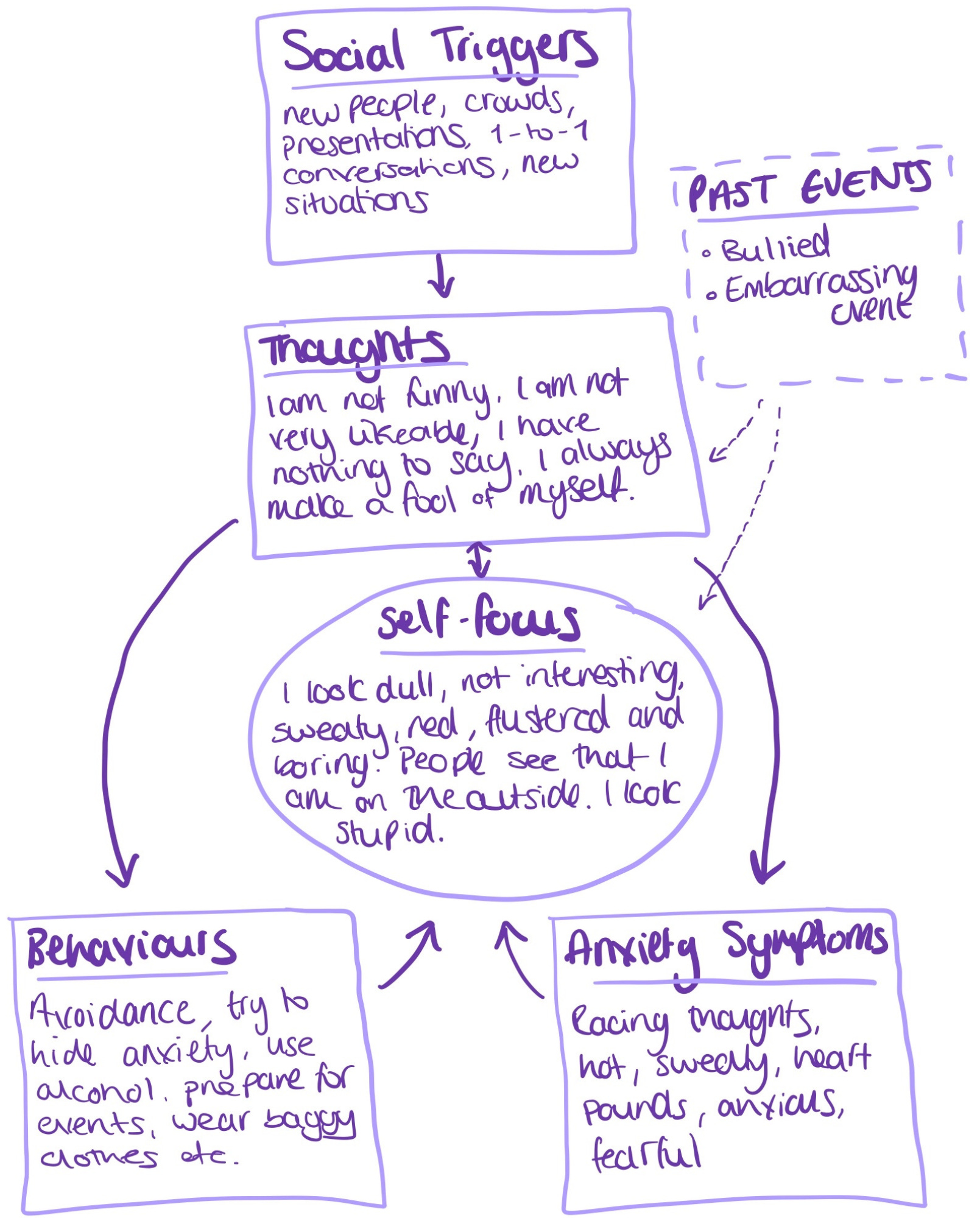
A SAD formulation can look something similar to the image below, but I will explain step by step what the components are. Starting from the top and following the arrows down.
Step 1: Understanding Triggers
In our day to day lives we are constantly put in social situations; we go to work/school/university, we need to go to the shops, we walk in public places or need to interact online with people. Each of these situations can ‘trigger’ someone's social anxiety. Social triggers are unique to the individual therefore understanding what may trigger a person is helpful to know what to work on.
Step 2: Understanding Thoughts and Beliefs
These triggers can cause people to experience various unhelpful thoughts, which tend to be based upon perceived judgments from others or individual insecurities. The example I give in the picture above include thoughts such as “I am not funny enough, I am not likeable, I have nothing to say, I always make a fool of myself.”
Step 3: Understanding Self-Focus
These unpleasant thoughts are naturally going to force us to become hyper aware of ourselves and how we are coming across to others. The next component of the diagram is labelled ‘Self-Focus’ and arguably the most important part of this formulation. The hyper awareness, caused by the situation and thoughts, often feels like there is a magnifying glass on us and that people can see what we are feeling. In this part of the formulation, we want to capture how we think we are being perceived or how we think we are coming across to others.
A useful analogy to help us understand self-focus can be:
“If you were a director in a movie about you, how would you tell the actor to look, dress, and appear in a social event?”
These words are often what our self-focus is and can include descriptions such as looking dull, stupid, boring, red, awkward, stiff, unable to talk and flustered.
Step 4: Understanding the Influence of the Past
Our thoughts and self-focus can be influenced by past events, especially if these events are linked to a social situation or judgments from another person. These events could include bullying; being told that we looked dull, red or sweaty. It could also be an event such as falling in front of a crowd which then laughs, resulting in us now believing that people will inevitably laugh at us for making mistakes.
Step 5: Understanding Feelings
From what I have described so far, these beliefs and events are bound to make us feel fearful, apprehensive or anxious in social situations. These feelings come hand in hand with physical sensations such as brain fog, feeling hot, heart pounding and other fight or flight responses. As a result of these sensations, we then feel more alert and on edge which significantly impacts the feeling that we are under scrutiny, therefore leading to our self-focus growing in intensity.
Step 6: Understanding Behaviours
To try and manage these sensations, feelings and thoughts we try to act in a way to hide these feelings. This can be a whole spectrum of behaviours from people talking and laughing too much to hide silences, to people becoming quiet and not sharing their true opinions. These behaviours feel as though they are helping, but in fact they can increase the intensity of self-focus and/or create faulty “evidence” for the beliefs we hold about ourselves. Safety seeking behaviours in social anxiety are normally unhelpful, and can lead to the social anxiety to be maintained over time.
All of these components - triggers, thoughts, self-focus, past events, anxiety symptoms and behaviours - feed into the negative cycle of social anxiety. In CBT, we would develop your formulation to help understand your cycles of social worries. Then, we would focus on de-bunking the self focus, challenging the beliefs you hold, minimising unhelpful behaviours and reducing anxiety. It can be a lot of work, but super rewarding!
**Disclaimer** If you do not have a diagnosis of social anxiety disorder, or any other condition for that matter, you can still reach out for help. If your life is being impacted by your mental wellbeing, and you feel that you have goals related to overcoming these challenges, then therapy is still an option. No matter where you are on the continuum of mental health, your problems are still valid and you deserve support.
Video of a Social Anxiety Formulation
References
[1] Lecrubier, Y., Wittchen, H. U., Faravelli, C., Bobes, J., Patel, A., & Knapp, M. (2000). A European perspective on social anxiety disorder. European psychiatry : the journal of the Association of European Psychiatrists, 15(1), 5–16. https://doi.org/10.1016/s0924-9338(00)00216-9
[2] American Psychiatric Association. (2013). Diagnostic and statistical manual of mental disorders (5th ed.). https://doi.org/10.1176/appi.books.9780890425596